The lunch rush at Rosie’s Diner was almost over when the three men in tailored suits walked in, laughing too loud, phones out, already filming.
“Get us something that won’t make us sick,” one smirked at Sarah, sliding his card across the counter like she wasn’t even worth eye contact.
She’d worked doubles for six years. Regulars loved her. But these men saw a faded apron and a name tag, nothing more.
“Sweetheart, you look like you peaked in high school,” another laughed, snapping a photo of her for “the group chat.” The third knocked his coffee cup off the table on purpose, watching it shatter at her feet. “Clean that up. It’s literally your job.”
Sarah knelt, gathering the pieces without a word. Her hands were steady. Too steady for someone who’d just been humiliated in front of a full diner.
Then, behind her, a chair scraped hard against the floor.
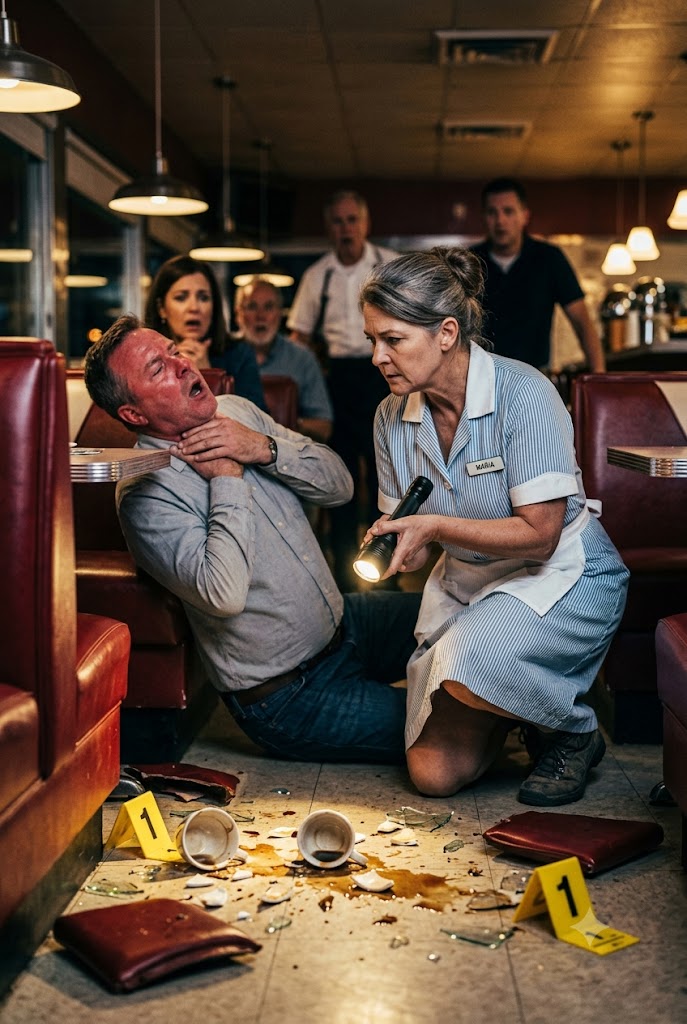
The oldest man at the table — the one who’d laughed the loudest — grabbed at his throat. His face was turning a deep, terrifying red.
Sarah’s eyes changed.
She stood up slowly, and for the first time all day, she wasn’t looking at the floor.
Continued in the comments 
For half a second, nobody moved. The man’s friends just stared, phones still raised, filming instead of acting. His chair tipped backward as he clawed at his collar, no sound coming out, lips turning a shade of blue that silenced the whole diner.
Sarah moved before she even finished thinking.
She crossed the floor in three strides, and something in the way she did it — low center of gravity, no wasted motion — looked nothing like a woman who spent her days refilling coffee cups. She got behind him, wrapped her arms under his ribs, and drove her fist upward with a force that sent his glasses flying off the table.
Nothing.
She didn’t panic. She adjusted her grip, angled her elbows the way she’d been trained a decade ago, and pulled again. On the third thrust, a piece of chicken shot across the counter and the man collapsed forward, gasping, sucking in air like he’d just surfaced from underwater.
The diner erupted into stunned silence, then a ragged cheer.
His two friends stood frozen, phones now hanging uselessly at their sides. The one who’d laughed the loudest ten minutes earlier was the one on his knees, sobbing, saying “thank you” over and over to the woman he’d just called worthless.
“Where did you learn that?” the younger man finally asked, voice shaking.
Sarah wiped her hands on her apron, the adrenaline already fading from her face. “Three tours as a combat medic. Kandahar, then two deployments after that.” She said it flatly, like she was reading a grocery list, not a résumé that could have silenced the whole room ten minutes earlier if she’d wanted it to.
“You’re a — you were a soldier?” the man on the floor stammered, still catching his breath.
“I still am, in the reserves,” she said. “I wait tables because the diner’s flexible around drill weekends. And because Rosie gave me a job when nobody else would hire a woman with gaps in her resume from three deployments.”
The man who’d knocked over the coffee cup — the one who’d filmed her on her knees cleaning it up — deleted the video right there at the table, hands trembling.
It turned out the man she’d saved wasn’t just some random customer. He ran the surgical department at the regional hospital two blocks away. Once he could speak properly again, he didn’t waste a second.
“I need people like you,” he said. “Not waiting tables. In my trauma unit. I don’t care what your resume gaps look like — I just watched you save my life with your bare hands in under a minute.”
Sarah almost laughed. Six years of being looked past, and it took nearly choking to death for someone to actually see her.
She didn’t gloat. She didn’t ask for an apology from the men who’d humiliated her twenty minutes earlier. She just picked the broken coffee cup pieces up off the floor, the same way she had before — steady hands, no drama — and finished her shift.
But something had shifted in that diner, and everyone who witnessed it knew it.
Three weeks later, Sarah started as a trauma nurse at County General. The diner regulars still stop by to ask about her. Rosie kept her old apron behind the counter, framed, next to a photo someone snapped of her mid-rescue — the only photo from that day nobody deleted.
The men in suits never came back. But the story did — passed table to table, shift to shift, growing a little each time, the way stories about ordinary people doing extraordinary things always do.
Because the truth is, you never really know who’s standing behind that counter, wearing that apron, taking that abuse with steady hands.
Sometimes the person you’re laughing at is the only one in the room who knows exactly what to do when everything falls apart.