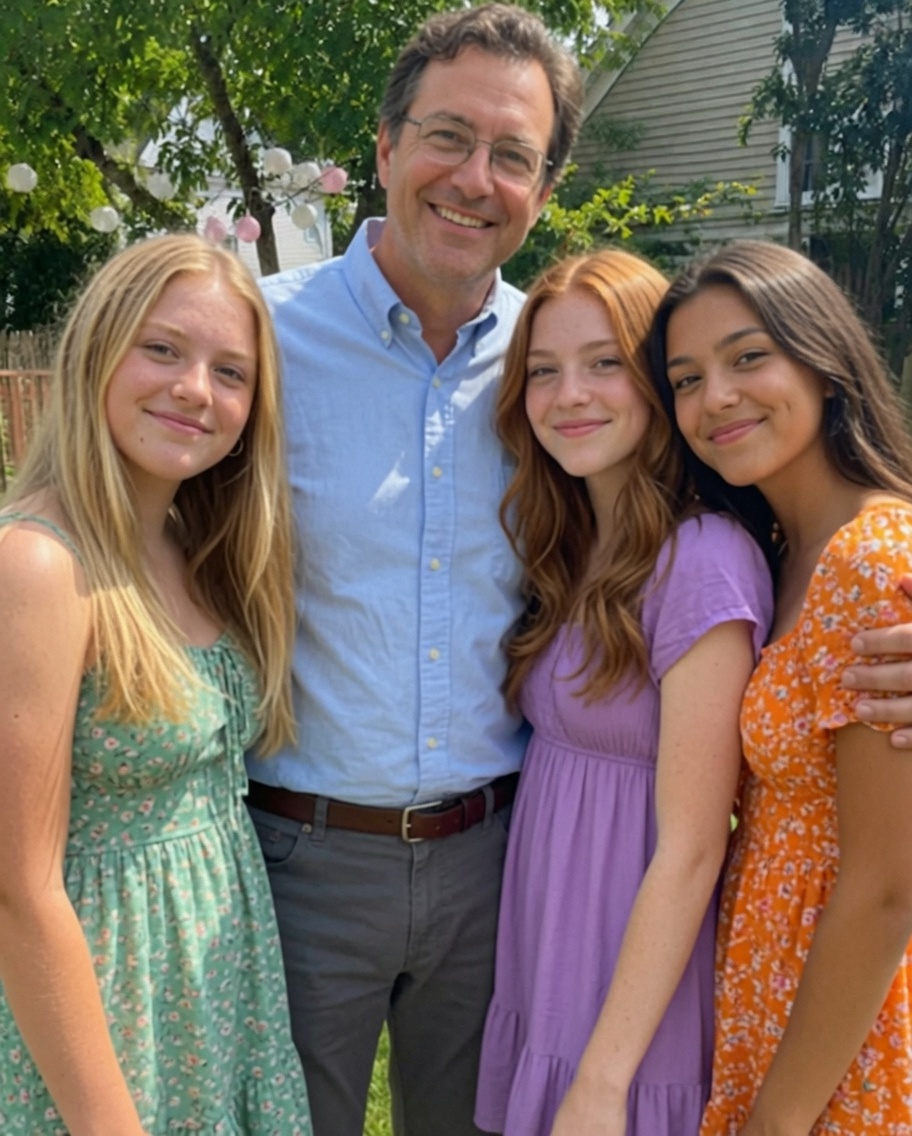
My wife drowned when our triplet girls were only two years old.
For fourteen years, I raised Wren, Sadie, and Poppy on twelve-hour shifts at the hospital and Sunday pancakes I burned more often than not.
I taught myself to French-braid their hair from grainy YouTube tutorials. I sat through every dance recital, every scraped knee, every 2 a.m. fever.
Whenever they asked about their mother, Claire, I told them the truth the Coast Guard had told me — she’d taken the sailboat out alone one Saturday, a squall came in fast, and the sea took her before anyone could reach her.
Her keepsakes I kept locked in a cedar chest in the basement — her wedding ring, a knit blanket she’d made for the nursery, and a sonogram photo where the nurse had drawn a small heart beside each of the three shapes.
Tonight was the girls’ sixteenth birthday.
By midnight the last guests were gone. I was alone at the sink with a stack of paper plates when I heard bare feet on the basement stairs.
It was Poppy. She was holding the cedar chest against her chest, the small brass lock hanging loose and broken.
In her other hand was a birthday card. Pink envelope. Yesterday’s postmark.
“Dad,” she whispered, her lip trembling. “This came in the mail today while you were at the store.”
She slid it across the counter.
I recognized the handwriting before I even touched it.
“Sweetheart,” I managed, “what is this?”
Poppy’s eyes filled with tears.
“You told us she drowned, Dad. But she mailed this on Thursday.”
Part 2 in the comments 👇👇
The card felt too light for what it was doing to my hands.
I sank onto the barstool. Poppy stood across from me, silent, waiting.
“Honey, this isn’t possible,” I whispered. “The Coast Guard found the boat. They found her jacket. Her wedding ring was still hooked to the zipper. They searched for three weeks.”
“Then open it, Dad.”
I couldn’t. My fingers wouldn’t obey. Poppy took the envelope back and slid a fingernail under the flap.
Inside was a small card, hand-drawn — three little birds on a wire, the way Claire used to sketch on the corners of grocery lists.
Poppy read out loud, her voice cracking on every other word.
“My girls. If you are reading this, you are sixteen, and I am the coward who has watched every birthday from a distance. Wren, my sparrow. Sadie, my starling. Poppy, my little wren-not-a-wren — I called you that the day the ultrasound tech said three, and your father laughed until he cried.”
I flattened my hand against the counter to keep from falling off the stool.
No one on earth knew that story. Not Claire’s parents. Not my brother. Nobody but me and the woman I had grieved for fourteen years.
Footsteps hurried down the hallway. Wren appeared first, then Sadie, both still in their birthday sweatshirts.
“What’s going on?” Sadie asked. “Why are you both crying?”
Poppy handed the card to her sisters without a word.
I watched Wren read it. Watched the color leave her face the way it does in the ER when someone gets news they weren’t prepared for.
“Dad,” Wren whispered. “Is this real?”
I couldn’t lie to them. Not tonight.
“It’s her handwriting. And what she wrote — no one could have made that up.”
Sadie sat down hard. “You said she died.”
“I believed she did. Every single day of the last fourteen years.”
“Then how is she writing us cards?” Wren’s voice rose. She flipped the envelope over. “How is she in a town in North Carolina, mailing us birthday cards like nothing ever happened?”
“I don’t know,” I said. “But I’m driving there tomorrow. And when I understand it, you will too. I promise.”
I left before sunrise.
The drive took eight hours. I spent every mile rehearsing what I’d say to a woman I had buried in my mind at twenty-nine.
The address led me to a small cottage with a garden out front. Claire opened the door on the first knock. Her hair had gone silver at the temples. She wasn’t surprised to see me. Only exhausted.
“Ethan.”
“You wrote to them.”
She stepped aside and let me in.
“When the girls were still babies,” she said quietly, sitting at a small kitchen table, “a cardiologist told me I had a rare heart condition. Six months, maybe a year. I couldn’t stand the thought of them watching me fade piece by piece. So I made a plan. I asked Maggie to help me.”
Maggie. Her best friend from nursing school.
“She worked in medical records. She helped me leave a paper trail that made sense. I sailed out that Saturday, swam to a marina three miles up the coast, and took a bus.”
“You let me identify a jacket, Claire. You let me tell our two-year-olds their mother was gone.”
“I know what I did. There is no version of me sitting here saying it was right.”
“So why write now?”
She looked down at her hands.
“Two years ago I finally went to a specialist. My scans were clean. They had always been clean. The first doctor had mixed up a chart. I’ve been healthy this whole time.”
The kitchen went silent.
“I sat with that for a year before I could pick up a pen. I promised myself I would wait until they were old enough to choose whether they wanted to meet me. Sixteen felt like that age.”
“Then come home with me. Face them.”
She shook her head. “Not unless they say yes first. I don’t get to walk back in on my terms. Not after this.”
I drove home in silence.
The girls were waiting on the porch when I pulled in — three of them wrapped in one blanket, the way they used to be at four years old.
I told them everything.
“What do you want to do?” I finally asked.
Wren went first. “We meet her. Together.”
Sadie squeezed my hand. “You’re still our dad. That doesn’t change.”
Poppy took the longest.
“I’ll go,” she said. “But I’m not calling her Mom. Not yet.”
I pulled all three of them close and let them see me cry for the first time in fourteen years.
Months later, I stood at the sink again, listening to the girls laugh on a video call with a woman they were still learning how to know.
The truth had cost us so much.
But the lie had cost us more.