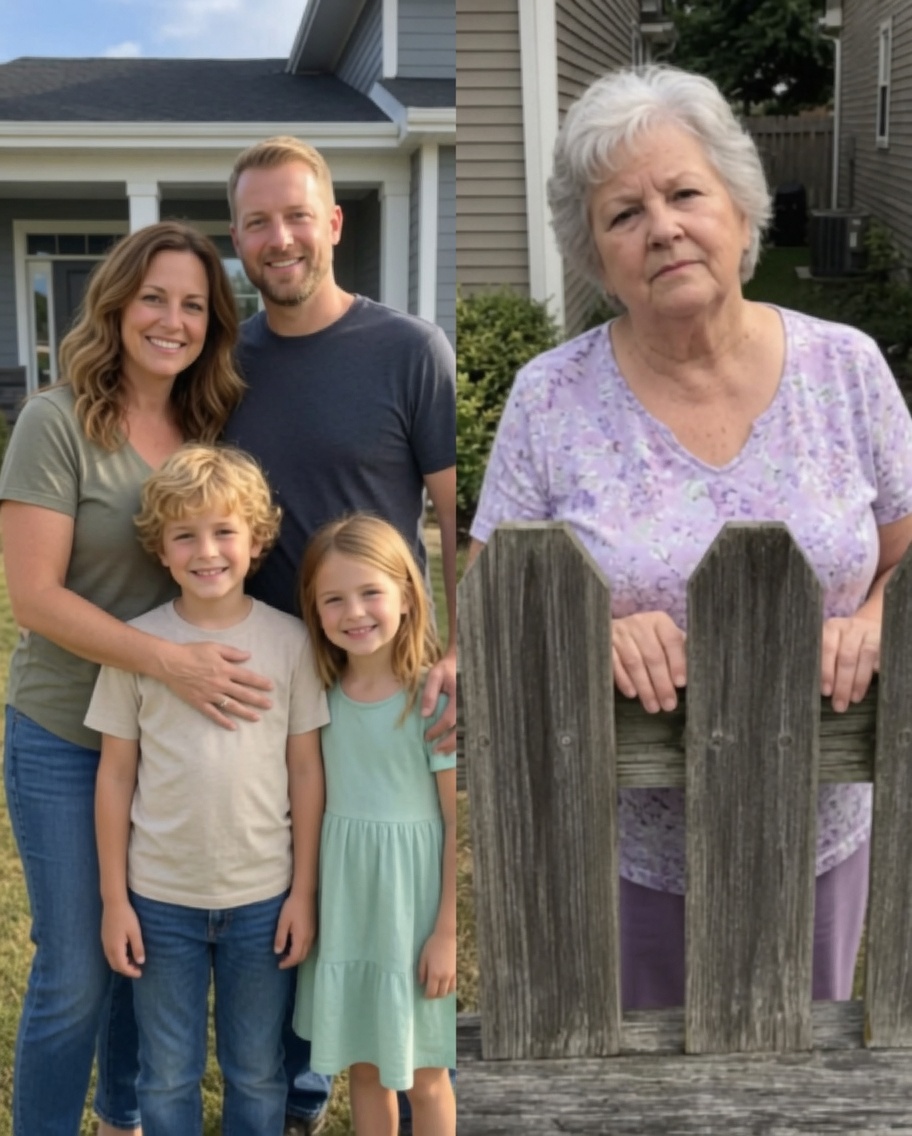
My name is Danielle. I’m 34.
After eleven years of renting cramped apartments, my husband and I finally closed on a small blue house at the end of a quiet cul-de-sac. Two bedrooms. A front porch. A pear tree in the yard.
Our daughter, Nora, and our four-year-old son, Miles, ran through the empty rooms like they’d been let out of a cage.
One week in, I found the first note on the porch.
Plain white paper. Sharp handwriting.
“Please instruct your daughter not to touch the pear tree. It is not decorative.”
I stared at it, confused. The pear tree was in our yard.
The next morning, another note.
“The child’s tricycle scraped the sidewalk again. This is not acceptable.”
I looked up and saw him. An older gentleman, maybe in his seventies, standing at his front window across the street. Watching.
I waved. He closed the curtain.
Over the next eight months, the notes kept coming. Then the complaints to the city. About our porch light. About Miles’s chalk drawings. About the wind chimes my mother had given us before she passed.
Without noticing, I started shrinking my family.
“Quiet feet, Nora.”
“Draw in the backyard, buddy.”
“Let’s take the chimes down, okay?”
Then one Saturday, I was washing dishes when Nora walked into the kitchen holding a folded piece of paper.
Her voice was so small.
“Mommy. The man across the street said if I keep smiling at him, he’ll make sure we have to move away.”
The plate slipped out of my hand and shattered on the floor.
I looked out the window.
He was standing on his lawn. Staring straight at our house.
I dried my hands and walked out the front door.
Part 2 in the comments 👇👇
I crossed the street barefoot.
I didn’t feel the pavement. I didn’t feel anything except my own heartbeat pounding in my ears.
He didn’t move as I approached. He just stood there in his gray cardigan, hands clasped behind his back, like he’d been expecting me for months.
“You spoke to my daughter.”
“I did.”
“She’s seven years old.”
“I’m aware.”
His calm made it worse.
“You told a little girl that you’d get us thrown out of our home. Do you understand what you’ve done to her?”
He looked past me, toward my house.
“I said what needed to be said.”
Something in me broke loose.
“For eight months I’ve apologized for existing next to you. My son doesn’t draw on our own driveway anymore. My daughter tiptoes in her own bedroom. I took down my mother’s wind chimes because you decided they offended you. And now you’re threatening a child?”
His jaw tightened, but he still wouldn’t look at me.
“You don’t know what that house is.”
I blinked. “What?”
“That house.” His voice cracked, just slightly. “The blue one. With the pear tree.”
“It’s our house.”
“It was my son’s house.”
The world went very quiet.
He finally turned his eyes to mine. They were pale and red-rimmed and exhausted.
“He bought it fifteen years ago. He planted that pear tree the summer his wife was pregnant. He painted the porch that color himself. He passed two winters ago. Heart. Forty-one years old.”
My throat closed.
“His wife couldn’t stay. Too many memories. She sold it in the spring. To you.”
I couldn’t speak.
“I watched your movers carry his life out to the curb,” he said. “I watched your children run on the grass he seeded. I watched your little girl climb his pear tree, and I—”
His voice failed him. He looked at the ground.
“I told myself if I could keep the house quiet, keep it still, keep it exactly the way he left it, then some part of him would still be there. And every time your children laughed in that yard, it felt like he was being erased all over again.”
Tears were streaming down his face now. He didn’t wipe them.
“I know how that sounds. I know what I’ve done. I wrote those notes because I couldn’t bring myself to knock. I couldn’t bear to see anyone else living in his kitchen.”
I stood there in the middle of the street, my anger and my heartbreak tangled up so tightly I couldn’t separate them.
“Sir.” My voice shook. “I am so sorry about your son. I truly am. I can’t imagine that grief.”
He nodded, staring at the grass.
“But my daughter came into the kitchen today shaking. She thinks she did something wrong by smiling at you. She thinks her joy is what’s going to make us lose our home.”
“I know.”
“That is not something a seven-year-old should ever carry. Not for you. Not for anyone.”
“I know.”
I took a breath.
“You don’t get to make my children small so your grief feels bigger. But I don’t want to be your enemy either.”
He looked up at me, surprised.
“That pear tree still has his hands in it,” I said. “The porch he painted is still the porch my kids run onto every afternoon. You are welcome to sit on it. You are welcome to tell my children stories about the man who planted that tree. You are welcome to be part of the life happening in that house instead of standing across the street watching it disappear.”
He put a hand over his mouth.
“But the notes stop today. The complaints stop today. And you will apologize to my daughter. In your own words. Gently.”
He nodded. He couldn’t speak.
“Take a day. Take two. Then come knock on our door. The front one.”
I turned and walked back across the street.
Nora was still at the kitchen window, both hands pressed against the glass.
I knelt down and pulled her into my arms.
“Baby. You didn’t do anything wrong. You never did. Not one thing.”
“Are we gonna have to move?”
“No, sweetheart. This is our home. It’s ours.”
Three days later, there was a knock on our front door.
He was holding a small paper bag. Inside were two pears from a tree in his own backyard, and a folded card with careful, shaky handwriting.
“To Nora. I’m sorry. Please smile at me again someday. — Mr. Halvorsen.”
She read it twice.
Then she looked up at him standing on our porch and gave him the smallest, bravest smile I have ever seen.
He cried right there in the doorway.
By fall, he was sitting on our porch on Sunday afternoons, telling Miles about the man who painted it blue.
And the pear tree kept growing. For all of us.