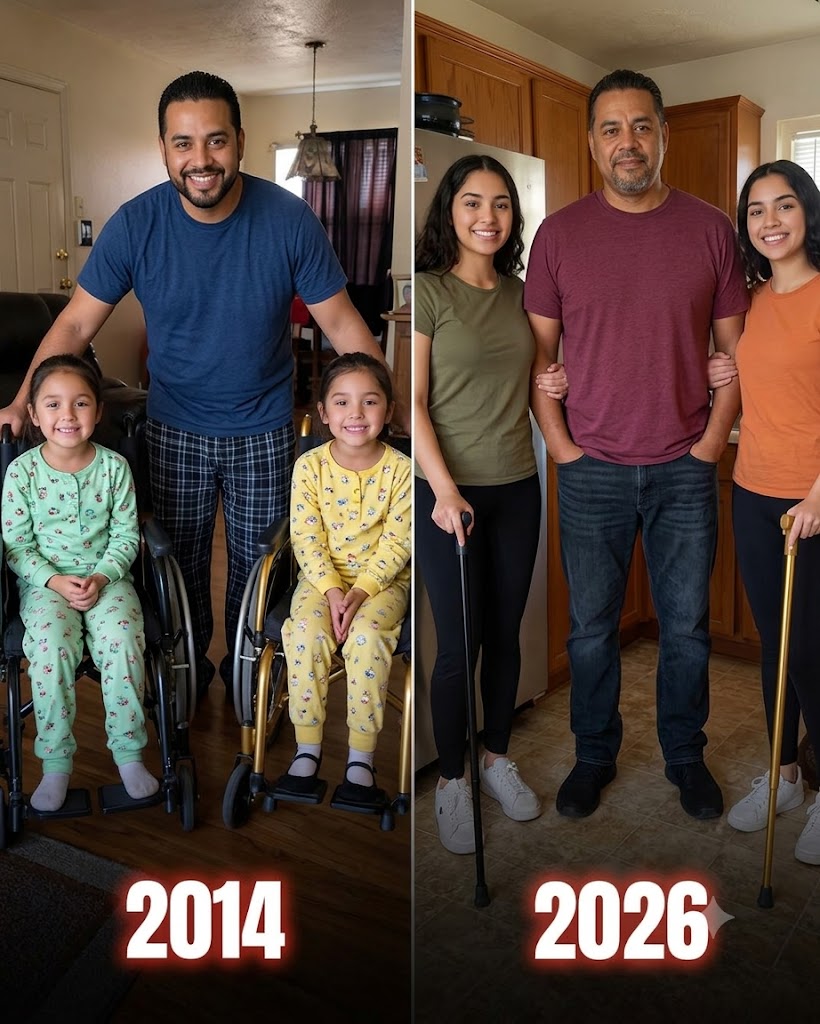
My kids were born two years apart, but the doctors used to say they moved through the world like a pair. Milo the quiet one, always reading. June the loud one, always climbing something she shouldn’t. They were seven and nine the summer June jumped off the porch railing to prove she could fly and landed wrong. Her femur snapped clean, and the pediatric orthopedist frowned at the X-ray for a long time before he ordered a bone density panel for both children.
The word was osteogenesis imperfecta. Mild form. Manageable. Not fatal. But it meant that a normal childhood — bike ramps, monkey bars, soccer, the trampoline in the yard — was over. It meant braces, calcium infusions, quarterly scans, and a specialist three hours away who did not take our insurance.
Their mother lasted eleven days after the diagnosis. I came home from a double shift at the plant and found her side of the closet empty and a Post-it note on the coffee maker.
I signed up for a family, not a hospital. The papers are with my lawyer. Don’t try to find me.
She kept that promise. Twelve years, and not one birthday card. Not one phone call. Not one bone she paid for.
I sold the truck. I sold the boat my father had left me. I picked up weekend security shifts on top of the plant job and then a third gig delivering auto parts on Sundays before dawn. I learned how to fit orthopedic braces at 5 a.m. in the kitchen light. I learned which grocery store threw out dented cans on Wednesday nights so I could stretch the food budget one more day.
The one luxury I let the kids keep was the public library. Every Saturday morning I dropped them at the children’s room on my way to the auto parts run, and they stayed there four hours until I picked them up. The librarian who ran the reading circle, a woman named Delphine, learned their names the first week. She learned June couldn’t sit on the hard floor without a cushion. She learned Milo would only speak if you asked him about the book, never about himself. She kept a plastic bin behind her desk with a pillow, a bottle of the specific electrolyte drink June needed, and a granola bar for Milo, who forgot to eat when he read.
I told her once I’d pay her back. She said, “For what? For doing my job?” and turned away before I could answer.
Twelve years of Saturdays. Twelve years of me pretending I didn’t notice how her face lit up when we walked in.
This year, June turned nineteen and Milo turned twenty-one. Both of them walking without braces for the first time since childhood. Both of them in college on full scholarships. And this year, for Father’s Day, they didn’t make me breakfast the way they always had.
Instead, June knocked on my bedroom door in a green dress I’d never seen and said, “Dad, put on the blue shirt. The one from Milo’s graduation. We have a reservation.”
“A reservation where?”
“You’ll see. Seven o’clock. Don’t ask questions.”
They drove me across town to a small Italian place on Warren Street called Bruno’s. I had never been inside. I had walked past it maybe a thousand times in twelve years and never once opened the door, because a plate of pasta there cost what I used to spend on groceries for a week.
The hostess seemed to know my children. She walked us to a table by the window with three chairs.
Three.
I looked at Milo. Milo looked at June. June looked at the floor.
“Who’s the third chair for?” I asked.
Neither of them answered.
The hostess set three menus down. Mine was on the bottom of the stack, and when I picked it up, I felt it — something folded inside, thin, the shape of a letter.
I opened the menu.
Inside was a piece of stationery folded in thirds, and I recognized the handwriting before I even unfolded it, because I had seen it on twelve years of overdue notices and reading-circle flyers taped to my refrigerator.
At the top of the letter, in blue ink, were four words.
If you say no —
The front door of the restaurant chimed behind me.
I turned around.
She was standing in the doorway in a coat the color of river stones, holding a small wrapped package against her chest, and she was already crying.
“Oh, kids,” I whispered. “What did you do.”
Continued in the c0mments 
I did not read the rest of the letter right away. I put it face down on the tablecloth and stood up, because my legs would not let me stay sitting while Delphine walked across a restaurant toward me for the first time in twelve years outside the walls of a library.
She stopped three feet from the table. Milo pulled out the fourth chair, which I hadn’t noticed the hostess sliding in behind me. June wiped her face with the back of her wrist and did not apologize.
“Sit down, Dad,” June said. “Please just sit down and let her talk.”
Delphine sat. She set the wrapped package on the chair beside her, not on the table, as if she wanted me to know it wasn’t the point of the evening. Her hands shook when she picked up her water glass.
“I asked them to do this,” she said. “The reservation was my idea. Don’t be angry with them.”
“I’m not angry,” I said, and it came out rougher than I meant it. “I’m scared.”
She almost smiled at that. “Scared of what?”
“Of every version of what you’re about to say.”
She looked at Milo and June. June nodded at her. Delphine took a breath.
“Four months ago,” she said, “your daughter came to the library on a Tuesday afternoon and asked if I had ever been married. I told her no. She asked if there was a reason. I told her the reason had been sitting in the children’s room every Saturday for twelve years and had never once looked at me long enough to notice I was looking back.”
I stared at the tablecloth.
“I told her I had made peace with it,” Delphine said. “That I had watched two beautiful children grow up in my reading circle, and that had been enough of a gift, and I did not need anything more from their father, who had earned the right to be left alone. And then your son —” she looked at Milo, who was gripping his water glass hard, “— your son asked me one question. He asked me if I had ever thought about what my life would look like if he and June stopped being the reason I stayed in the same job in the same town for twelve years.”
Milo’s voice, when he spoke, was very quiet.
“Dad. She turned down a head librarian job in Portland six years ago. We didn’t know until this spring. She turned it down because she didn’t want to leave the reading circle.”
“She didn’t want to leave us,” June corrected. “Which means she didn’t want to leave you. And she has been sitting in that library every Saturday for twelve years pretending it was about the books.”
I could not look up.
“Twelve years ago,” Delphine said, more softly, “you walked into my library with a broken little girl in a wheelchair and a little boy who wouldn’t take his coat off, and you asked if it would be all right if they stayed for the reading circle even though you couldn’t afford the twelve-dollar summer program fee. I told you the fee was waived. It wasn’t waived. I paid it out of my own pocket every summer for eleven years, and I would have paid it for the rest of my life, and I never told you because I was afraid you would stop bringing them.”
June was fully crying now. Milo was staring at the ceiling. I picked up the letter with hands I could not steady and turned it over.
If you say no, I will never mention any of this again, and I will still be at the library on Saturdays if the children ever want to visit. If you say yes, I would like to have dinner with you sometime that is not planned by your children. I am not asking for a future. I am asking for a Tuesday.
— Delphine
I read it twice. Then a third time. Then I folded it very carefully along the same creases and put it in my shirt pocket, over my heart, because that is where I put things I do not want to lose.
“June,” I said. “Milo.”
“Yeah, Dad?”
“How long have you two been carrying this?”
June answered without hesitating. “Since I was thirteen. Since the day she stopped the reading circle early to drive us to the emergency room when Milo fainted and you were three hours away at the plant and couldn’t answer your phone. She stayed with us until you got there at two in the morning. You didn’t see the way she was looking at you when you walked into that waiting room. We did.”
“Six years,” I said.
“Six years,” Milo said. “We didn’t say anything because you kept telling us that the day we stood up on our own would be the happiest day of your life, and we didn’t want you to have a happier one before that. But we’ve been standing for a while now, Dad. And you’re still living like you’re waiting for permission.”
I put both my hands flat on the table because I did not know what else to do with them. Across the table, Delphine was very still, waiting for me to tell her the answer either way, and I could see in her face that she had already prepared herself for the kind one and the cruel one and would survive both.
“Tuesday,” I said.
She blinked.
“Tuesday works,” I said. “Not here. Somewhere cheaper. I’d like to pay.”
She started laughing and crying at the same time. June made a noise that was somewhere between a sob and a cheer. Milo put his forehead down on the table and left it there.
“There’s a diner on Grafton Street,” I said. “The pie is good. I’ve been walking past it for twelve years and thinking someday I’d take somebody there.”
“Tuesday at the diner on Grafton Street,” Delphine said. “Seven o’clock?”
“Seven o’clock.”
The waiter came then, because he had been hovering at a polite distance for what must have been ten minutes, and asked if we were ready to order. June ordered for all of us in a voice that shook. Milo lifted his forehead off the table. Delphine slid the wrapped package across to me.
Inside was a library card. A brand-new one, in my name, with today’s date on it.
“You’ve never had one,” she said. “In twelve years of dropping them off, you never checked out a book of your own.”
“I didn’t have time to read.”
“You have time now.”
I sat there in a restaurant I could not afford, on a Sunday I had been dreading for twelve years, across from a woman who had waited longer than any human being should have to wait, with two children who had loved me hard enough to plan a rescue behind my back — and I understood, finally, what my son had been trying to tell me.
I had spent twelve years teaching my kids how to stand.
They had spent the last six teaching me how to sit down.